
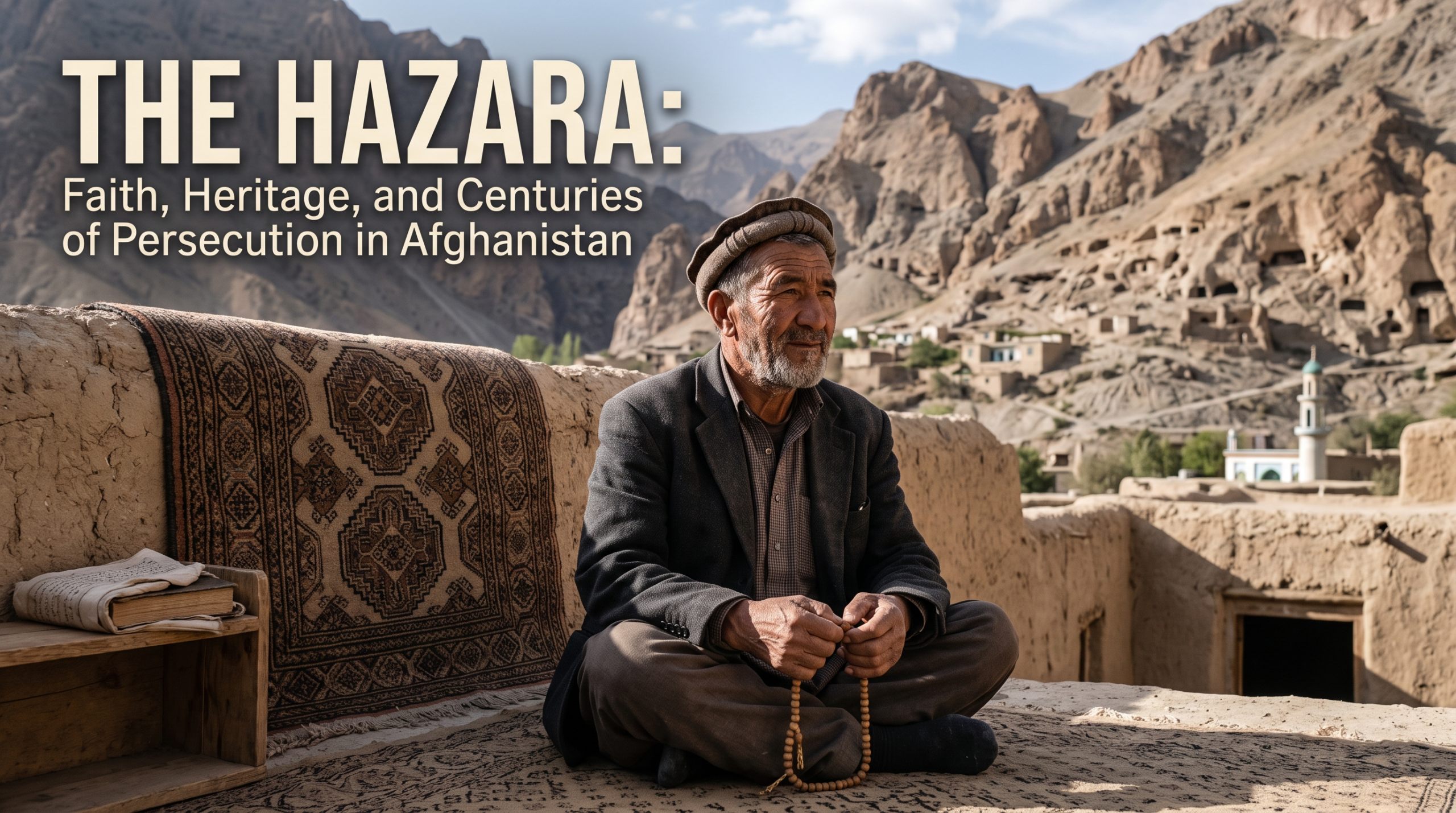
The Hazara people are an indigenous ethnic community residing in the central highlands of Afghanistan, known historically and geographically as the Hazarajat (or Hazaristan). Over successive centuries, and acutely under the fundamentalist rule of the Taliban, the Hazara have faced systemic subjugation, forced displacement, cultural erasure, and mass atrocities.
Understanding why the Hazara endure continuous hostility requires an examination of intersecting fault lines: sectarian divergence within Islam, ethnolinguistic origins, geopolitical conflicts dating back to the late nineteenth century, and their distinct socio-cultural values.
1. Etymology and Identity: What Does “Hazara” Mean?
The origin of the name Hazara has long intrigued historians, linguists, and anthropologists.
Linguistic Roots
- The Persian Word Hazār (هزار): The predominant scholarly consensus traces the name to the Persian term for “one thousand”.
- The Mongol Military Link (Ming or Mingan): When Genghis Khan and his successors organized their armies, military units were divided into decimals—tens, hundreds, and thousands (mingan or ming). As these military garrisons settled in the Hindu Kush and Central Asian frontier regions, the term was translated into Persian as Hazār, eventually evolving into the ethnonym for the people living in those territories.
- Alternative Hypotheses: Other regional etymologists suggest localized indigenous origins derived from pre-Mongol Bactrian or Turkic topographs, such as the ancient fortress of Hazar-sum.
Ethno-Linguistic Reality
- Language (Hazaragi): The Hazara speak Hazaragi (هزارگی), an eastern dialect of Persian (Dari) enriched with significant Mongolian and Chagatai Turkic loanwords, idioms, and grammatical structures.
- Physical Features: Most Hazaras exhibit distinct Central Asian, Turco-Mongol physical phenotypes, setting them visibly apart from Afghanistan’s predominantly Indo-European ethnolinguistic populations (such as Pashtuns and Tajiks). This visual distinctiveness has historically made them vulnerable to quick identification, segregation, and selective violence.
2. The Ancestral Homeland: Hazarajat (Hazaristan)
The traditional home of the Hazara is the rugged, isolated central mountain massif of Afghanistan.
       [ Hindu Kush Mountains / Baba Range ]
                       │
       ┌───────────────┴───────────────┐
       │     Hazarajat (Heartland)     │
       │  • Bamyan     • Daykundi      │
       │  • Ghor       • Ghazni        │
       │  • Wardak     • Uruzgan       │
       └───────────────────────────────┘
- Geography & Climate: Encompassing provinces such as Bamyan, Daykundi, parts of Ghor, Ghazni, Uruzgan, and Wardak, this region features elevations between 2,000 and 4,000 meters above sea level. Winters are harsh and prolonged, requiring intense communal reliance and resilience.
- Terrace Agriculture & Pastoralism: Hazaras developed complex terraced irrigation channels along steep valleys, cultivating wheat, barley, and legumes while herding sheep in high-altitude alpine pastures.
- Strategic Isolation: The impenetrable topography of the Koh-e-Baba and Hindu Kush mountains served as a natural defensive fortress for centuries, shielding the community from expanding empires and external conquerors until modern centralized state artillery emerged in the late nineteenth century.
3. Religion and Sacred Geography
Religion serves as the primary ideological pretext for Taliban hostility toward the Hazara.
Shia Islam in a Sunni-Dominant Landscape
- Twelver Shia (Ithna’ashari): The overwhelming majority of Hazaras adhere to the Ja’fari school of Twelver Shia Islam, with a notable minority practicing Ismaili Shia Islam.
- Doctrinal Cleavage: The Taliban adhere to a strict, fundamentalist synthesis of the Deobandi school of Sunni Hanafi jurisprudence and Pashtunwali (the Pashtun customary code). Extremist factions view Shia rituals—such as Tawassul (intercession) and Azadari (mourning rites)—as forms of religious deviation or outright heresy (Takfir), framing violence against the Hazara as an act of doctrinal purification.
Sacred Sites and Cultural Shrines
- The Bamyan Valley: Home to the monumental 6th-century cliff-carved Buddhas of Bamyan (destroyed by the Taliban in March 2001). For Hazaras, Bamyan is not merely an archaeological site; it is their cultural cradle and a symbol of their ancient civilizational roots.
- Band-e-Amir: Afghanistan’s first national park, located in Bamyan. According to Hazara folklore, the six mineral-rich, sapphire-blue lakes were created by miraculous interventions of Imam Ali (the cousin and son-in-law of the Prophet Muhammad), endowing the terrain with spiritual significance.
- Ziyarat-e-Sakhi & Regional Shrines: Local shrines (Ziyaratgah) throughout Hazarajat and the Dasht-e-Barchi district of Kabul serve as community hubs for prayer, remembrance, and communal solidarity during Ashura and Muharram commemorations.
4. History: From Independent Enclave to Internal Colonization
The historical relationship between the central Afghan state and the Hazara has been defined by systematic marginalization and state-directed violence.
| Historic Era | Prevailing Dynamics | Impact on the Hazara |
|---|---|---|
| Pre-1880s | Autonomous tribal confederacies; self-administered valleys | Hazaras managed internal affairs independently of Kabul |
| 1888–1893 | The Campaigns of Emir Abdur Rahman Khan | Genocide, mass enslavement, loss of arable ancestral lands |
| 1920s–1970s | Institutional segregation under the Musahiban Monarchy | Exclusion from civil service, restricted higher education, punitive grazing laws |
| 1979–1989 | Soviet Invasion & Civil Resistance | Emergence of autonomous militias; consolidation under Hezb-e Wahdat |
| 1996–2001 | First Taliban Regime | State-sanctioned massacres (Mazar-i-Sharif, Robatak, Yakawlang) |
| 2001–2021 | The Republic Era | Civic renaissance, mass educational enrollment, constant suicide attacks |
| 2021–Present | Second Taliban Regime | Evictions, systemic exclusion, disarmament, IS-KP targeting |
The Cataclysm: Abdur Rahman Khan’s War (1890–1893)
The turning point in Hazara history occurred under Emir Abdur Rahman Khan (“The Iron Emir”). Seeking to build an autocratic, centralized state, he issued religious decrees (fatwas) branding the Hazara as infidels (Kafirs), mobilizing Sunni tribes across the southern and eastern regions against them.
- Casualties & Displacement: Historical estimates indicate that over 60% of the Hazara population was killed, starved, or driven into exile in British India (notably Quetta, modern-day Pakistan) and Tsarist Central Asia (Mashhad, Iran).
- Forced Confiscation of Land: Thousands of fertile agricultural plots in Uruzgan and Kandahar were seized and redistributed to nomadic Pashtun tribes (the Koochis), pushing surviving Hazaras deeper into barren mountainous crags.
- Institutionalized Slavery: Hazaras were legally bought and sold in Kabul and Kandahar markets until slavery was officially abolished under King Amanullah Khan in the 1923 Constitution.
5. Visionaries and Leaders of the Hazara
The modern political consciousness of the Hazara was forged through charismatic religious and military leaders who sought civil parity and constitutional guarantees.
Abdul Ali Mazari (1946–1995)
- Title: Revered by Hazaras as Baba Mazari (“Father Mazari”) and posthumously named “Martyr of National Unity.”
- Role: Founder and secretary-general of Hezb-e Wahdat Islami Afghanistan (The Islamic Unity Party of Afghanistan). Mazari unified fragmented Hazara resistance groups into a coherent political and military coalition during the anti-Soviet resistance and subsequent civil war.
- Political Philosophy: Mazari advocated for a federalist system in Afghanistan, equitable resource distribution based on ethnic population ratios, and institutional recognition of Shia personal status law. He argued that peace would remain unattainable so long as one ethnic group sought total dominance over the others.
- Death: Captured, tortured, and killed by the Taliban in March 1995 after being invited to negotiate political terms outside Kabul.
Sultan Ali Keshtmand
- Role: Prime Minister of the Democratic Republic of Afghanistan during the 1980s.
- Significance: As a secular Hazara politician, he attained one of the highest executive offices in modern Afghan history, demonstrating the Hazara commitment to state governance, institutional administration, and modernization programs despite widespread discrimination.
Sima Samar & Habiba Sarabi
- Sima Samar: A physician who founded the Shuhada Organization, served as the Minister of Women’s Affairs, and led the Afghan Independent Human Rights Commission (AIHRC), advocating for human rights and women’s education.
- Habiba Sarabi: Appointed governor of Bamyan Province in 2005, she was the first female provincial governor in Afghanistan’s history, reflecting the Hazara community’s support for female civic leadership and education.
6. Why the Taliban Systematically Persecute the Hazara
The hostility of the Taliban toward the Hazara is structural, ideological, and historic, rather than incidental.
                  ┌───────────────────────────────┐
                  │ Core Drivers of Persecution   │
                  └───────────────┬───────────────┘
          ┌───────────────────────┼───────────────────────┐
          │                       │                       │
          ▼                       ▼                       ▼
    [ Ideological ]         [ Ethnocentric ]        [ Socio-Cultural ]
  • Deobandi Takfirism    • Pashtun Hegemony      • Gender Equality
  • Anti-Shia Sectarianism• Historical Land Feuds • Secular Education
  • Wahhabi Influences    • Pashtunwali Dominance • Democratic Values
1. Theological Sectarianism (Takfirism)
The Taliban’s governance is based on a rigid, literalist interpretation of Sunni Islam. Hardline commanders and foot soldiers frequently view Shia Islam as an apostate tradition. In August 1998, following the capture of Mazar-i-Sharif, the Taliban governor Mullah Manan Niazi delivered public speeches over mosque loudspeakers declaring:
“Hazaras are not Muslims, they are Shiites. They are infidels. They must convert to Sunni Islam, leave Afghanistan, or face death.”
This doctrinal stance has repeatedly been used to rationalize summary executions and the desecration of Shia religious spaces.
2. Ethnic Chauvinism & Historical Land Disputes
While the Taliban brand themselves as an Islamic movement that transcends tribal divisions, their core leadership and ranks remain predominantly Pashtun. The lingering territorial conflicts between the settled Hazara farmers and nomadic Pashtun Koochi herders (who carry land-grant documents from Emir Abdur Rahman dating to the 1890s) continue to ignite disputes over arable land and pastures every spring.
3. Contrasting Worldviews: Education and Gender
During the Republican era (2001–2021), the Hazara embraced modern civic institutions, higher education, human rights protections, and democratic processes:
- Hazara provinces, such as Bamyan and Daykundi, consistently achieved the highest rates of female school enrollment, university matriculation, and literacy in the country.
- The community placed heavy emphasis on modern professions: medicine, software development, arts, journalism, and philosophy.
This progressive social shift stands in direct contrast to the Taliban’s vision of a tribalized, patriarchal society governed by strict, traditional gender roles.
7. The Present Day: Systematic Atrocities and the Threat of Genocide
Since the collapse of the Western-backed Republic and the return of the Taliban to power in August 2021, the Hazara face acute vulnerabilities across political, economic, and security fronts.
Evictions and Land Seizures
Under the renewed Taliban regime, local courts systematically rule against Hazara farmers in longstanding property disputes with nomadic Koochi groups. Entire villages across Daykundi, Uruzgan, and Balkh have faced forced evictions with only a few days’ notice, leaving thousands internally displaced.
Exclusion from Governance
The current Taliban administration has dismantled democratic institutions, suspended the 2004 Constitution, and nullified the Shia Personal Status Law. The cabinet remains almost exclusively Pashtun-Sunni clerics, stripping the Hazara of meaningful representation in executive, judicial, or military bodies.
Dual Vectors of Violence: Taliban Inaction and IS-KP Attacks
The Hazara community faces ongoing attacks from both the ruling regime and rival insurgent factions:
- Islamic State – Khorasan Province (IS-KP): An ideologically hostile, ultra-salafist entity that routinely targets Hazara civilians. Major suicide bombings have hit maternity hospitals, girls’ schools (e.g., the Sayed Al-Shuhada school bombing and the Kaaj Educational Center attack), sports arenas, and Friday prayer services in Dasht-e-Barchi, Kabul.
- Taliban Disarmament Policies: The de facto authorities have actively disarmed Hazara neighborhood watch groups and community security units, while failing to provide basic security protections for schools, shrines, and community centers.
A Community of Unbroken Resolve
The history of the Hazara is marked by significant adversity, characterized by survival against state-sponsored violence, displacement, and systemic marginalization. The Taliban’s enduring hostility stems from this fundamental divergence: a fundamentalist, mono-ethnic movement clashing with an indigenous community defined by its Shia faith, distinct ethnolinguistic heritage, and commitment to education, equality, and civil rights.
Despite enduring severe persecution, the Hazara continue to defend their cultural heritage, relying on their history of resilience across the mountain redoubts of the central highlands.
Leave a Reply